

How to Save a Dying Tree in Miami
You can save a dying tree in Miami if you catch the cause early and the roots and trunk are still alive.
Most declines start below ground, with cut roots, compacted soil, or too much or too little water.
The fix is patient care, not a quick spray. Your first job is to stop adding stress.
Is Your Tree Dying or Just Stressed?
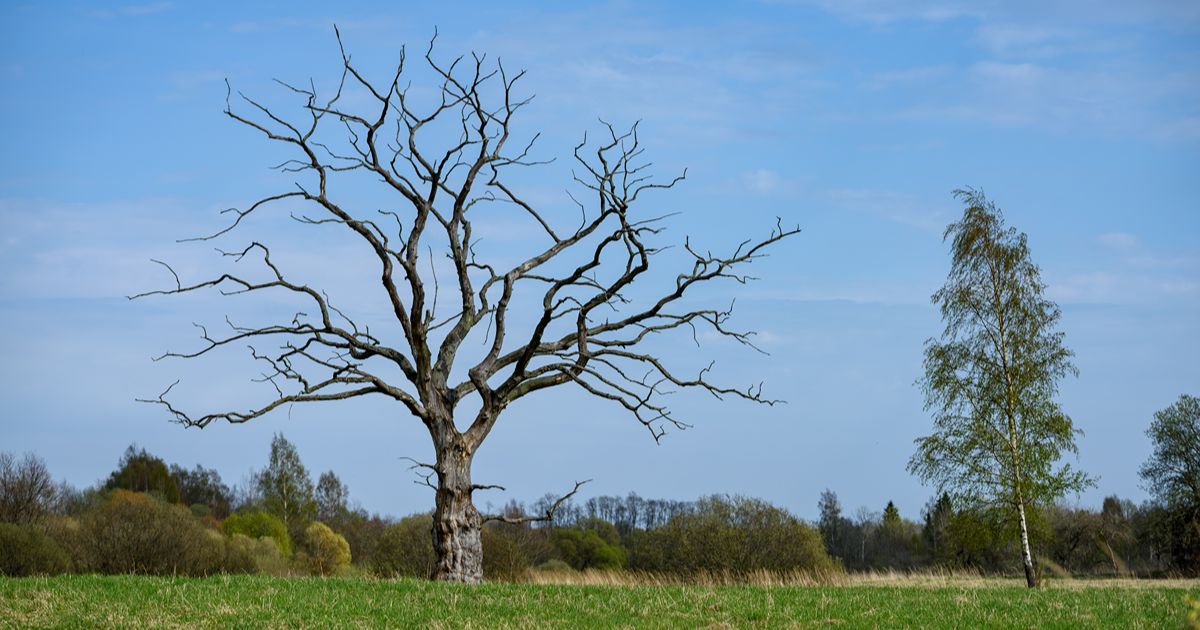
A stressed tree still has live tissue and buds. A dying tree is losing them.
Scratch a small spot of bark on a twig with your thumbnail. Green, moist tissue means that part is alive. Brown and dry means it is dead. Work from the branch tips toward the trunk to see how far the dieback runs.
Then look for these signs:
- Leaves only on the lower or inner branches
- Bark falling off in sheets
- Mushrooms or shelf fungus at the base
- Cracks, cavities, or soft wood in the trunk
- A new lean that was not there last month
These match the most common signs of a dying tree. Leaf drop alone is not always bad news. Some Miami trees thin out in the dry season and push new leaves when the rains return.
What Kills Trees in Miami Most Often?
Root damage is the usual culprit. Miami soil is thin and sits on limestone, so most roots stay close to the surface. That makes them easy to hurt.
Watch for these local triggers:
- Construction and trenching. A new pool or driveway can cut roots you never see. UF/IFAS notes trees can decline from construction damage for as long as 20 years after the work ends.
- Fill piled over roots. Raising the grade around a tree cuts off the air its roots need.
- Packed soil. Cars, equipment, and even foot traffic compact the soil.
- Roots that wrap the trunk. Girdling roots slowly choke a tree. UF/IFAS warns that once a girdling root is wider than 25% of the trunk, you may not be able to remove it.
- Pests and disease. Scale, borers, and whiteflies hit weak trees first. Check for common Miami tree pests and dangerous tree diseases like laurel wilt.
Timing matters too. UF/IFAS has found that trees weakened by a long drought often die soon after normal rains return. Wet soil wakes up root fungi, and a weak tree cannot fight them off.
Steps to Save a Dying Tree in Miami
Start with the roots, then work up.
- Stop the panic care. A UF/IFAS Extension agent puts it simply: when a plant starts to decline, the first thing to do is nothing. Do not flood it or dump fertilizer on it.
- Clear the root flare. Pull soil and mulch back until the first large roots show.
- Mulch the root zone. Spread 2 to 3 inches of mulch out toward the edge of the canopy. Keep it off the trunk. Remove grass under the tree where you can.
- Water deep, not often. In the dry season, soak the soil under the canopy with about 1 inch of water (roughly 0.6 gallons per square foot) every 2 to 4 weeks during extended dry periods. Apply it slowly and evenly from near the trunk to the drip line, aiming to moisten the top 12 inches of soil. Let the top layer dry out between waterings.
- Loosen packed soil. An arborist can use an air excavation tool to break up hard soil without cutting roots.
- Remove dead wood only. Cut dead and broken branches. Leave live growth, since the tree needs its leaves to make food.
- Support weak limbs. If a split or weak union is part of the problem, an arborist may cable a weak limb instead of cutting it off.
- Treat only what is confirmed. Fertilizer and pesticide help only when a diagnosis shows a real need.
The UF/IFAS dieback guide lists these same root zone fixes. Recovery is slow. Expect several weeks to a few months before you see healthy new leaves; in more severe cases, it may take a full growing season or longer for the canopy to recover.
What Not to Do to a Struggling Tree
Heavy pruning is the most common mistake. Cutting off big live limbs to “help” a weak tree strips away the leaves it uses to feed itself. Topping a declining tree almost always speeds its death.
These moves also backfire:
- Watering every day. Soggy soil feeds root rot.
- High nitrogen fertilizer. It pushes soft new growth that weak roots cannot support.
- Volcano mulching. Mulch piled against the trunk holds water on the bark and invites rot.
- Waiting out a crack or lean. That is a safety problem, not a health problem.
When a Dying Tree Cannot Be Saved
Some trees are past saving. If most of the crown is dead, the trunk is rotting, or fungus grows from the base or roots, recovery is unlikely. UF/IFAS says little can be done once root rot fungi like Armillaria or Ganoderma take hold.
A dead or rotting tree near a roof, car, or sidewalk can fail without warning, and the risk climbs in hurricane season.
An ISA certified arborist can check for hidden decay and tell you if the tree is safe to keep.
If it isn’t, tree removal in Miami may require a county permit, so check before anyone cuts.
Get a Diagnosis Before You Buy a Treatment
Every declining tree has a cause, and the fix depends on that cause. Do the scratch test today, clear the root flare, and stop any heavy watering or feeding.
Then have a certified arborist look at the roots and trunk before you pay for sprays or injections. You can find one near you in the ISA arborist directory.