

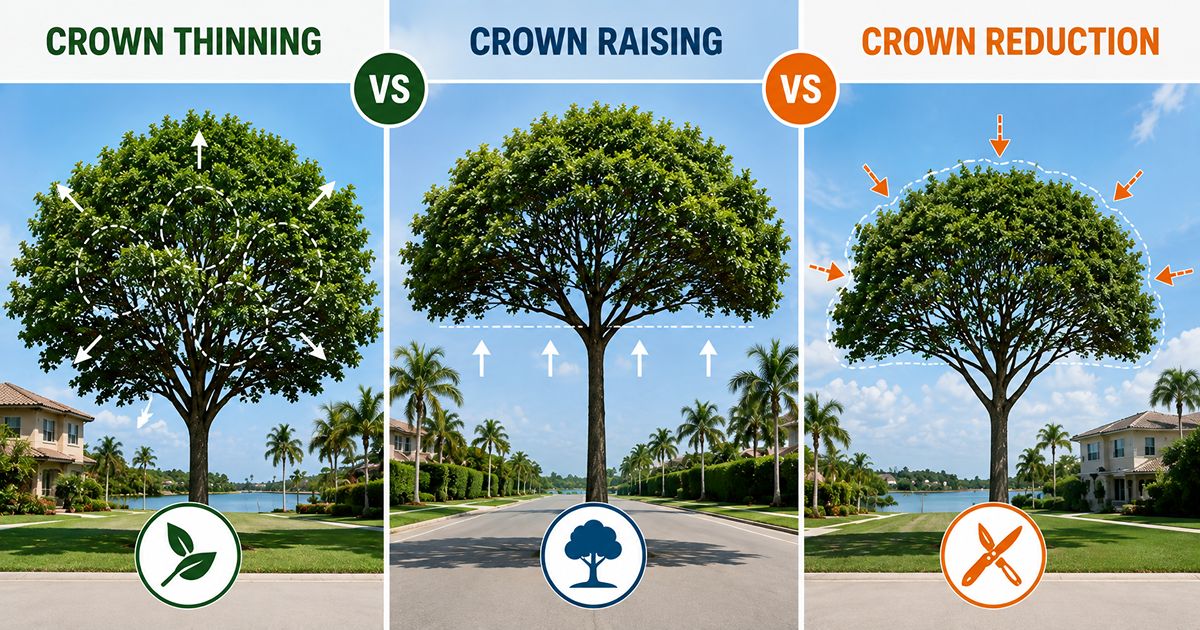
Crown Thinning vs. Crown Raising vs. Crown Reduction in Miami
Crown thinning, crown raising, and crown reduction are three separate pruning cuts that fix three separate problems.
- Thinning opens the inside of the canopy.
- Raising lifts the lowest limbs off your roof or driveway.
- Reduction shortens the tree so it takes up less space.
Most South Florida homeowners get all three quoted under one word, trimming, and that is where the money and the tree both get wasted.
Crown Thinning vs. Crown Raising vs. Crown Reduction
Thinning takes branches out of the middle. Raising takes them off the bottom. Reduction takes length off the ends. Same tree, three targets, three very different results.
Match the cut to the goal:
- Too dark under the tree, or too much sail in a storm: thinning
- Branches scraping the roof, the gutter, or the car: raising
- Tree too tall or too wide for the spot it sits in: reduction
- Dead or broken wood only: none of the three; that is cleaning
It helps to know that the crown and canopy are not quite the same thing, since crews use both words loosely on estimates.
What Crown Thinning Really Does, and When It Backfires
Thinning removes a small number of live branches spread evenly through the canopy.
The goal is airflow and light, not a hollow tree. A properly thinned oak still looks full from the street.
The failure mode is common enough to have a name. Lion-tailing means stripping out the interior growth and leaving foliage bunched at the branch tips.
The tree looks tidy for a season. Then the weight sits at the ends of long limbs, and every limb turns into a lever the next time a tropical system comes through.
Bark that spent decades in shade also burns in full sun.
Miami-Dade County names lion-tailing, topping, and hat-racking as improper pruning that can amount to the effective destruction of a tree and a violation of the county code. That is a code problem, not just a look problem.
Here is the part crews rarely say out loud: most healthy mature live oaks in South Florida do not need thinning at all. We see far more trees hurt by unnecessary thinning than helped by it.
If you want a stronger tree before hurricane season, structural pruning before storms does more than opening up the canopy.
When Crown Raising Is the Right Call
Raising is for clearance. You remove or shorten the lowest limbs so the tree stops hitting the roof, the fence, the sidewalk, or the delivery truck.
The best time to do it is early. University of Florida horticulturists recommend shortening low branches over several visits while they are still small, so the trunk wounds stay small when those limbs finally come off.
Waiting until a low limb is eight inches thick means one large wound that may never close.
The mistake is raising too far. Strip a mature tree up fifteen feet, and you get a bare pole with a heavy top, which is worse balance, not better.
On a tree already leaning, raising can make the lean look tidier while doing nothing about the load.
If that is your situation, read what to do about a tree leaning toward the house before anyone cuts.
Crown Reduction Is Not Topping
Reduction shortens a limb back to a living side branch that is large enough to take over as the new leader.
Topping cuts wherever the saw lands. That single difference decides whether the tree heals or rots.
The working rule from UF/IFAS is that the remaining lateral branch should be at least one third the diameter of the portion removed, though this varies with species, age, and tree condition.
Ask your crew that question directly. A real arborist answers it without pausing.
Reduction also comes with a commitment. Once you reduce a tree, growth comes back fast, and the tree needs to stay in that reduced form from then on.
Budget for repeat visits, not one visit. Our fuller breakdown of reduction pruning walks through when it is worth doing.
Palms Get None of These Three Cuts
None of the three apply to palms. A palm has no branching crown to thin, no side laterals to reduce to, and no lower limbs to raise.
Cutting green fronds up into a tight “hurricane cut” removes the food the palm needs and weakens the bud it cannot replace.
Palm trimming rules are their own subject entirely.
The Miami Rule That Caps All Three Cuts
Miami-Dade County allows trimming without a permit, with two conditions. The work must follow ANSI A300 standards, and no more than 25 percent of the leaves may be removed from each branch. That cap applies whether the crew calls the job thinning, raising, or reduction.
Individual cities inside the county set their own pruning thresholds, and some require a permit once you pass a percentage of the canopy in a year.
Removal is a separate process with its own rules, covered in our guide to tree removal permits.
If a company tells you a permit never matters in Miami, that is your signal to get another quote for tree trimming in Miami from someone who works inside the code.
Name the Goal Before You Name the Cut
Homeowners get better work when they describe the problem instead of ordering a technique.
Say “the branches are on my roof” or “this tree is too tall for the lot,” and let a certified arborist pick the cut.
Before you sign anything, ask which of the three cuts is being used, what percentage of live foliage is coming off, and what the tree will need in two years.
Any crew that cannot answer all three should not be in your tree.